 Enlarge Image

Debussy, Claude (1862-1918)
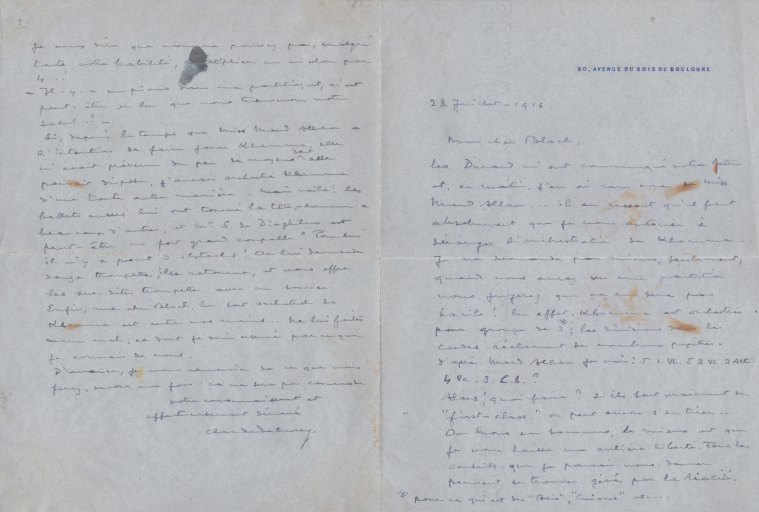
Autograph Letter Signed
"Claude Debussy". 80 Avenue du Bois de Boulogne, July 28, 1916. 2pp. of a folded sheet with Debussy's address on top. Overall excellent condition; a few minor stains and one ink smudge.A remarkable letter between two of the most prominent composers of the 20th century, with Debussy writing in detail about Bloch's making a reduction of Debussy's ballet Khamma. While in New York in 1916 as conductor of Maud Allen's traveling dance troupe orchestra, Bloch realized the score for the ballet was too large for the troupe's small orchestra. Bloch had long admired Debussy and wrote to him asking permission to make a reduction. Bloch requested reducing the original number of sixty or more musicians to an orchestra of about forty.
Debussy writes that the Durands [the publishing firm] have communicated your letter to me, and this morning I received a letter from Miss Maud Allan. It seems to me that it is absolutely necessary that I give you authorization to arrange the orchestration of "Khamma." I do not know how you will manage it, precisely, when you have a score in which you will find that everything has been written with a great deal of care! …It won't be easy …In fact, "Khamma" is orchestrated in groups of 3; the divisions of the desks require many players, according to Miss Allan, there are: 5 first violins, 5 second violins, 3 violas, 4 cellos, 3 double basses. So what are we to do? If the strings are really "first-class", one can perhaps manage somehow…there is a piano in my score, and it is perhaps there that you will find your salvation. I give you complete liberty….Any advice I might give you would , in any event, be contradicted by reality….despite all your skill, you cannot multiply one violin by four…If Miss Maud Allen had indicated the means she had at her disposition, I would have orchestrated "Khamma" in a completely different manner, but, there we are! The Ballets Russes have turned her head and Mr. S. de Diaghilev is perhaps too great a [?] ? For him there are no obstacles! They ask of him a dozen trumpets and he finds them and offers you the said trumpets with a smile. In the end, my dear Bloch, the orchestral fate of "Khamma" is in your hands… I’m certain you won't do any harm to it because I know you. Debussy concludes by thanking Bloch for what you are doing and I say once again: it won't be easy. Your grateful and devoted…
The Swiss-born American composer Ernest Bloch is especially known for his Jewish-related works, cited by Ernest Newman as the first truly Jewish composer the modern world has known, even though he wrote many works that were not specifically in that expression. Bloch came to New York in 1916 to become the conductor of the orchestra for the Canadian choreographer Maud Allan's traveling dance troupe, staying to become a composition teacher at the Mannes College. In 1920, Bloch became the first director of the Cleveland Institute of Music, in 1925 he became the director of the San Francisco Conservatory of Music, and in 1940 Bloch took a professorship at the University of California at Berkeley.
